

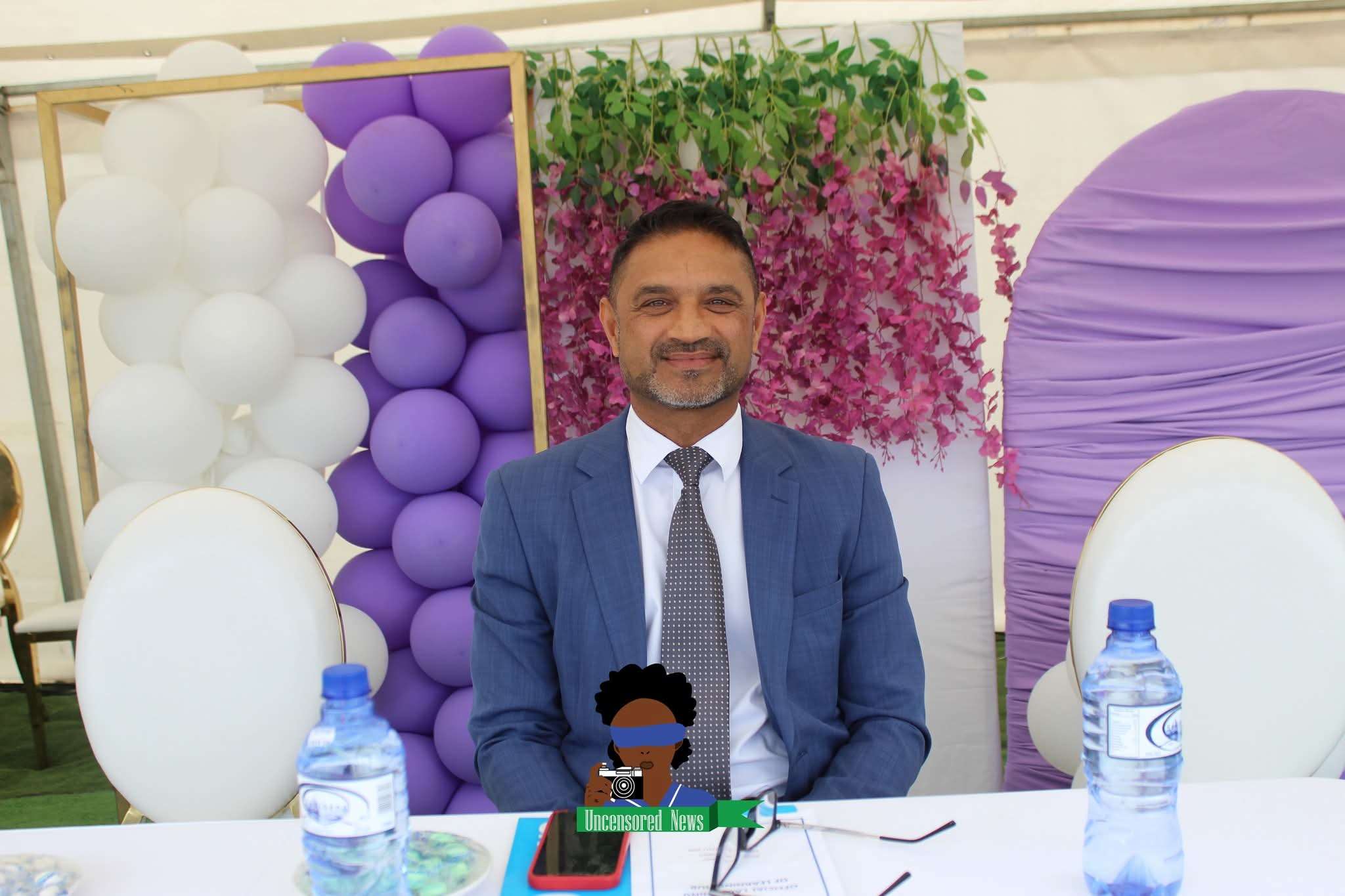
“Lesotho Literally Gave Me My Heart Back”
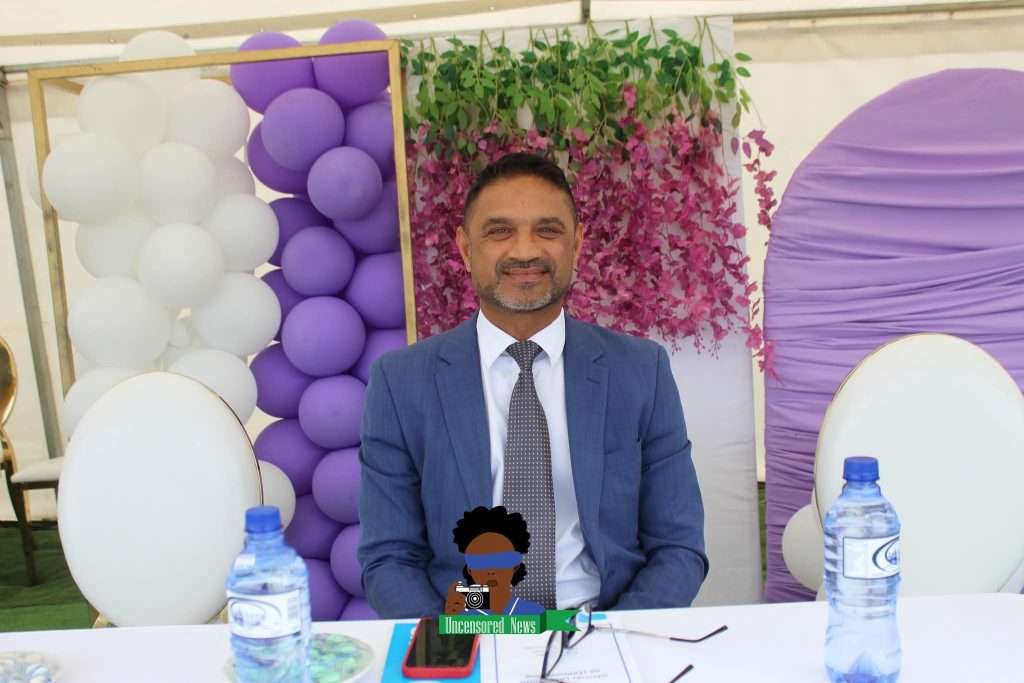
23 June 2026 by Pascalinah Kabi
Less than five feet away from a group of private sector representatives, Deepak Bhaskaran stood almost at the centre of the hall, his left hand resting over his right just below the hem of his suit jacket.
He nodded, clapped, and occasionally stretched out his right hand in appreciation as speaker after speaker reflected on how the United Nations Children’s Fund (UNICEF) Lesotho had successfully unlocked M40 million Multiplier Grant from the Global Partnership for Education (GPE) to support equitable and inclusive access to quality education in Lesotho.
Each movement briefly revealed the watch beneath his sleeve — a subtle reminder of the passage of time and the end of a chapter for a man whose mission in Lesotho comes to an end on 30 June 2026. Partners, colleagues, and friends had gathered to bid him farewell.
Among them was Dennis Plaatjies, Chief Executive Officer of Econet Telecom Lesotho, who on 10 June 2026 delivered remarks on behalf of the private sector.
“When someone concludes a successful assignment, it is usually customary to reflect on their achievements, the programmes they have led, the resources they have mobilised, and the milestones they have delivered,” Plaatjies began.
For advertising rates and partnership deals, contact us on uncensored.news.lesotho@gmail.com or +266 63782619 or +266 57451863. Alternatively, you can contact Limpho Sello on +266 63360521 or Pascalinah Kabi on +266 63503672.
Without wasting time, and as though mindful of the limited time available, he reminded the gathering of about 50 guests of what Bhaskaran and his team had accomplished for the children of Lesotho with support from various institutions and international organisations.
“I would like to speak first about something less measurable, yet equally important. I believe many people in this country who have interacted with Deepak can attest that he connected exceptionally well with people,” he said, triggering a burst of applause across the hall.
The room, dotted with about 15 cocktail tables carefully arranged in an arch, seemed to echo the sentiment. As guests exchanged pleasantries and forged new connections, the atmosphere reflected the very qualities Plaatjies was describing.
It was as though Bhaskaran’s influence extended beyond the programmes he led and the funds he helped mobilise. His approach to building relationships had quietly shaped the gathering itself, turning a farewell event into a celebration of connection and partnership.
“Throughout his tenure in Lesotho, Deepak brought a spirit of partnership to everything he did. He listened, he engaged, and he connected people,” Plaatjies said.
“My heart is full
In June 2022, Bhaskaran arrived in Lesotho — a country renowned for its rugged mountains and breathtaking landscapes. Known as the “Kingdom in the Sky,” Lesotho is the only independent nation in the world whose entire territory lies above 1,000 metres (about 3,280 feet) above sea level, with its lowest point sitting at approximately 1,400 metres (4,593 feet) above sea level.
It was against this dramatic backdrop, and amid one of the most challenging public health crises in modern history, that Bhaskaran began his assignment in the mountain kingdom.
Four years later, Bhaskaran is leaving Lesotho with a simple but profound reflection: “My heart is full.”
“But it certainly feels like today is not an ordinary day for me,” Bhaskaran said during his farewell on 10 June 2026.
“Today is a day of gratitude. Today is a day of reflection. As I stand before you, my heart is full.”
He went on to explain what had filled his heart during four years of working to advance the protection, wellbeing, and rights of children in Lesotho.
“Full of memories, full of appreciation, and full of pride in what we have achieved together for the children of the great Mountain Kingdom.
“When I arrived here in Lesotho, almost four years ago, in June 2022, as you have seen me in the masks photo, I came here with a vision to listen, to learn, and to walk alongside the government and the people of Lesotho in advancing the rights and wellbeing of every child,” Bhaskaran said.
Now, he stood before partners and colleagues reflecting on a journey that had transformed both UNICEF’s work and its partnerships in the country.
He said he was leaving the Mountain Kingdom humbled by the generosity of its people, strengthened by the partnerships forged over the years, and inspired by the courage, resilience, and promise of Lesotho’s children.
Please support Uncensored News journalism by donating from as little as M10 through Mpesa: 51863, Ecocash: 120668 and Nedbank Lesotho: 11990336867. By supporting this initiative, you are strengthening journalism that writes stories from the people, by the people.
Among the partnerships he helped cultivate was an unprecedented collaboration within the private sector, bringing together telecommunications competitors in support of children’s welfare.
“One of them is over there in the corner,” Plaatjies said, pointing towards a display highlighting the M40 million, made possible through contributions from Lesotho’s private sector— ECONET’s HigherLife Foundation, Vodacom Lesotho Foundation, and Standard Lesotho Bank.
“The most significant was the successful unlocking of the M40 million Global Partnership for Education Multiplier Grant.
“These achievements brought together competitors — Econet and Vodacom Lesotho. Really, I don’t think people would have thought we could all stand together and support each other in such initiatives. But that gentleman, Deepak, was able to say, ‘These ones, I will bring them together,’” Plaatjies said.
He indicted that through Econet and Vodacom’s respective foundations, Higher Life Foundation of Lesotho and the Vodacom Foundation, the two companies partnered with UNICEF Lesotho, the Ministry of Education and Training, and the Standard Lesotho Bank to advance educational opportunities and outcomes for Lesotho.
“What makes this achievement particularly remarkable was not only the level of funding that was secured, but also the powerful example it set.”
“Working with you has been easy”
As UNICEF Lesotho Deputy Representative Bob Muchabaiwa invited guests to gather for the speeches, government officials, development partners and other guests gradually settled into their places around the hall.
On the far right sat government ministers — Lejone Mpotjoane of Energy and Mining, Pitso Lesaoana of Social Development and Gender, and Richard Ramoeletsi of Public Service. Across the room, Acting Principal Secretary in the Ministry of Health, Matšoanelo Monyobi, stood alongside Refiloe Kepa, Deputy Principal Secretary in the Ministry of Education and Training, and United Nations Resident Coordinator Taija Kontinen-Sharp.
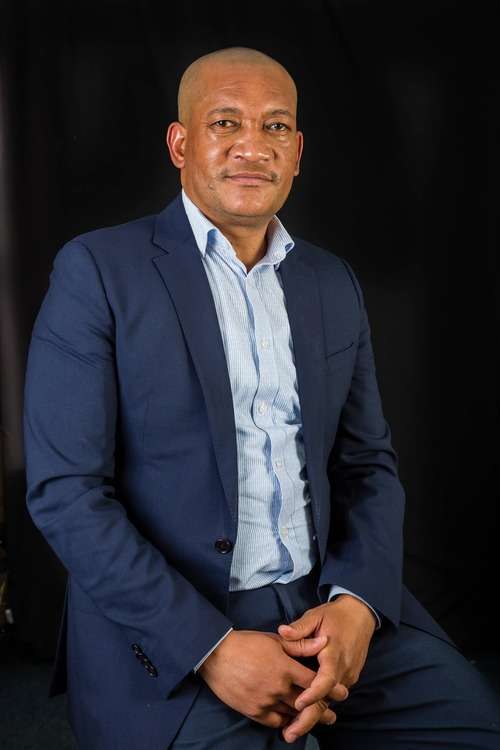
When the time came for the government’s tribute, Lesaoana took to the podium and reflected on his experiences working with Bhaskaran.
His thoughts drifted back to a visit he had made with Mpotjoane to Lesotho’s mountainous regions for the launch of a clean energy project that would transform lives in remote communities.
“And we were connecting about a thousand households there. It has been easy to work with you,” Lesaoana said.
He recalled one particular story shared during that visit — a story that illustrated the profound impact of bringing electricity closer to isolated communities.
“One of the stories that we heard when we were there was that the project is cutting almost six hours of walking time. People used to spend three hours going and another three hours returning just to charge a phone for the children there. The numbers behind you speak for you,” he said.
For Lesaoana, the impact extended beyond energy access. He pointed to the digitisation of social protection systems and the strengthening of government databases as examples of reforms that would continue benefiting Basotho long after Bhaskaran’s departure.
“From more than 25,000 child protection grants being digitised to nearly 29,000 people being registered on NISSA, if we can get everyone onto the system, it will become much easier for us to implement and coordinate our programmes. With the click of a button, you can identify who qualifies for support and who is most vulnerable,” Lesaoana said.
Then, speaking on behalf of the Government of Lesotho, he delivered a simple farewell.
“On behalf of the government, farewell.”
“Lesotho gave me my heart”
Shortly after, Bhaskaran explained that Lesotho gave him something deeply personal, which he reveals that he keeps talking about it to his wife, all the time.
“Lesotho gave me warmth. It gave me friendship, and above all, something very close to me, which is my heart, both figuratively and literally,” Bhaskaran said.
Although he did not go into details, he hinted having a medical challenge connected to his heart when he first came to Lesotho.
“And in that process, when I did my usual medical check, the doctor told me, the size of my heart is slightly bigger than usual.
And of course, my son was there to help me because he was a medical student. And it looks like, I don’t know whatever medical term it is, it helped me to, what they call, that this is driving. Action is hard,” Bhaskaran explained.
He then went on to explain how welcoming the people of Lesotho have been to him and his team for the past four years.
“You, your country, your people, and our partners as well, have a free heart. If you stay in touch with people with a big heart, your heart automatically becomes bigger. And literally, and this one I’m bragging.
“When I run through the mountains here, every morning, the fresh, crispy air. When you see these children with the school bags in their back, and say, Good morning, ntate, that’s an energy jolt I get.”
Transformative contribution
Across health and nutrition, education, child protection, water and sanitation and social protection, UN resident coordinator Taija Kontinen-Sharp, said UNICEF’s contribution has been deep and transformative.
“I haven’t been in the Lesotho for very long, but, it does not take long to see what UNICEF has meant to this nation,” Kontinen-Sharp said.
She added: “And if one thing has actually stood out to me in the last three months of being in this country, it is that UNICEF really understands that partnership is not a strategy, it’s the work itself, which I hope everyone will say.”
She explained that the United Nations succeeds only when everyone move together – with government, global partners, civil society, traditional leaders, communities, and the private sector.
Kontinen-Sharp praised UNICEF for being “a quiet force” in alleviating those problems, keeping children at the centre of every plan and priority.
“Through advocacy at the highest level, UNICEF has helped place children at the top of the national agenda. The role of Her Majesty the Queen, as UNICEF’s most recent international champion, has been truly remarkable.
“Lending her voice and stature to education, child protection, health and clean water and sanitation, has spurred the nation to attend to the well-being of its children. Similarly, UNICEF has also shown what determined resource mobilisation can achieve.”
Then, Kontinen-Sharp turned from institutions praise to celebrating the captain of the ship – Bhaskaran.
“That’s a deep hug. This evening gives us a chance to thank you for your leadership, your collaboration, your unwavering commitment.
“Your contribution reached well beyond UNICEF. You helped advance my collective priority, we are at our best when we work as one collective and one family. In the United Nations, we often speak of our leadership framework because we like big words.
But in Deepak, we have seen them live through action. Principled in standing up for every child’s right. Inclusive in bringing every factor to the table, as we’ve heard,” Kontinen-Sharp said.
“You have an amazing team”
Among the partnerships forged during Bhaskaran’s tenure was the European Union-funded Metsi a Lesotho programme, one of the country’s most ambitious water, sanitation and hygiene initiatives in recent years.
Launched in May 2024, the programme seeks to expand access to clean water and sanitation services in rural communities while protecting Lesotho’s water and land resources for future generations.
With a €27 million (approximately M540 million) investment from the European Union, the initiative is expected to construct or rehabilitate water, sanitation and hygiene facilities in 250 rural communities, 125 schools and 15 health facilities across the country.
UNICEF plays a central role in the programme, overseeing the expansion of water and sanitation services in rural communities, schools and health facilities.
Beyond infrastructure, the initiative also seeks to strengthen water governance, improve data systems and support ReNOKA, Lesotho’s national movement to restore degraded land and water resources.
By the time Bhaskaran leaves Lesotho at the end of June 2026, the Metsi a Lesotho programme has already begun delivering results. In May 2025, government officials, the European Union and UNICEF commissioned the first water, sanitation and hygiene facilities under the programme at St. Sebastian High School in Mohale’s Hoek, marking an early milestone in a project designed to benefit communities across all ten districts over five years.
At the farewell dinner, Anna Renieri, Head of Cooperation at the European Union mission in Lesotho, described working with Bhaskaran and his UNICEF team as a productive partnership.
“In the Global Partnership for Education, in Metsi a Lesotho, we supported WASH facilities in schools and clinics. We also worked to support youth activities in the community, ensuring that they have a voice and that they can reach decision-makers through that voice,” Renieri said.
She added that one of the most valued aspects of the partnership was UNICEF’s advocacy for universal access to education.
“And that’s where we also appreciated very much the work with you, Deepak and your team, is on the advocacy towards universal access to education,” she said.
Renieri praised Bhaskaran’s leadership style, saying it was defined by trust in his team.
“You have an amazing team, and that says a lot about you as a leader in terms of inspiration and support,” she said.
“I think sometimes the ability to let your team go first, to give space and latitude for every member to explore their potential, is harder for a head of office than doing the work itself. So in that sense I recognise a very strong ability from your side.”
She also highlighted his use of technology in daily work.
“Your love for technology — there are people who still rely on paper and printed speeches,” she said.
“You have all my admiration for your ingenuity in using phone-based translations of speeches from Sesotho to English. What I appreciated was your strong willingness to apply technology in our work in a way that is beneficial to our goals.”
In the end, those gathered at the farewell cocktail agreed in applause with Dennis Plaatjies’ closing words:
“We wish you and your family every success, happiness, and fulfilment in the years ahead. Your story has been enriched by your presence here, and we are grateful for the time that you have spent among us. Thank you.”
