

Climate Change Forces Lesotho’s Farmers to Choose Between Feeding Families and Livestock
Climate change is pushing rural farmers in Phamong, Mohale’s Hoek, into painful choices: whether to feed their families or their livestock. As drought erodes rangelands and water sources, farmers struggle to produce enough food for both humans and animals.
1 December 2025 by Pascalinah Kabi
Est. Read Time: 4 min
Listen to this article:
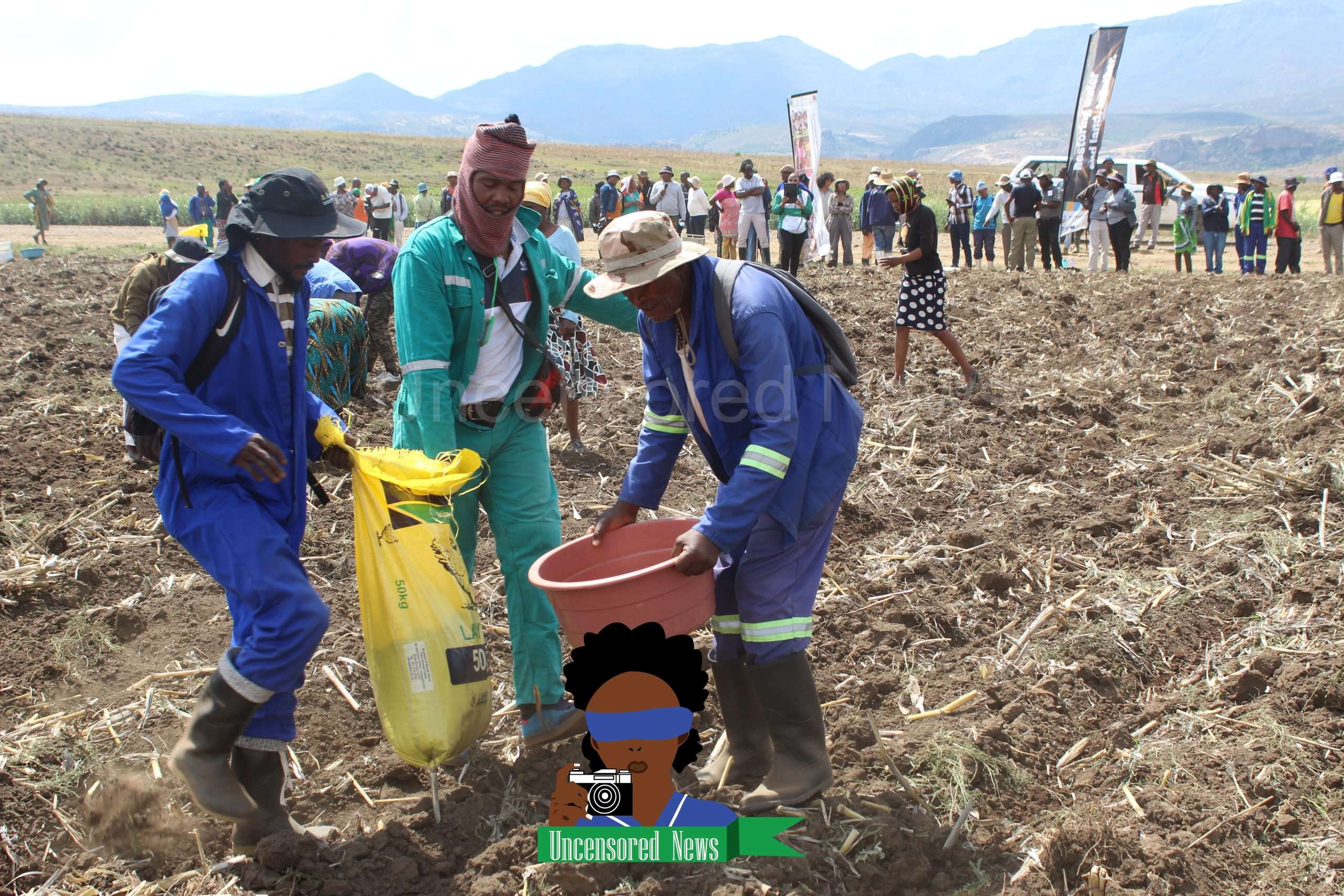
A sluggish wind scrapes across the blackish, clay-heavy soil of Phamong, carrying dust and the weight of a changing climate. Bent over the land, farmers move steadily along rows of tender fodder seedlings, sealing each line with care.
This hands-on training in Mohale’s Hoek aims to give farmers more than technique. It offers them a lifeline: the hope of producing reliable, nutritious feed for their animals at a time when many are being forced to choose between feeding their families and keeping their livestock alive.
In Lesotho — as in much of southern Africa — livestock is more than property. It is a backbone of rural economies, particularly for farmers in places like Phamong.
“In Lesotho, livestock production is experiencing some measure of growth and thereby contributing to income generation, employment creation, mitigating food insecurity in addition to providing organic fertilisers and draught power,” reads a 2024 research by Motlatsi Ramochela.
But Ramochela also warns that most of the country’s rangelands are degraded, largely due to poor farming practices that have paved the way for invasive plant species. His study, Effect of Land Management Practices in the Lowlands on Grass Productivity and Soil Properties in the Rangelands of Lesotho, highlights an urgent need for alternative approaches.
Recognising the deteriorating state of rangelands — and the pressure this places on livestock farmers — ReNOKA has partnered with the Rural Self-Help Development Association (RSDA) to help communities in Mohale’s Hoek and Leribe grow fodder as a sustainable alternative.
According to ReNOKA’s Lephatsoe Tsiane, the partnership was prompted by concerns about the health of Lesotho’s three major rivers — Makhaleng, Senqu and Mohokare — which are increasingly filled with soil washed down from degraded rangelands and farms where communities like Phamong depend for their livelihoods.
“ReNOKA’s responsibility is to bring together government ministries working in the environment, water and livelihoods sectors to ensure we conserve, preserve and protect the environment,” Tsiane said. “We also work with community-based organisations and CSOs on environmental protection, which is why we partnered with RSDA.”
Tsiane added that ReNOKA has engaged RSDA to support communities with livelihood programmes. “I want to thank RSDA for ensuring that government ministries and CSOs work together so that the environment and people can co-exist. When it comes to fodder production, the Department of Range will talk about fodder, the Ministry of Agriculture will talk about fodder — but often not together. We are working to end this era of stakeholders operating in silos,” he said.
But even promising solutions come with difficult trade-offs. Speaking on 6 November 2025 during an RSDA-organised dialogue bringing together farmers, researchers from the National University of Lesotho and the Lesotho Agricultural College, government representatives, and funder ReNOKA, Phamong farmers’ representative Senkane Motakabone captured the dilemma plainly.
“We face challenges with the environment and natural resources — soil and water are our main challenges,” he said. “Arable land is very limited, and because of that, we are forced to prioritise food production for our families. We fear that if we prioritise fodder, we might go hungry.
“Lack of water is also a serious challenge. Even when we plant fodder, the yields are low. Since we only plant in small areas, so we can still grow food crops, the situation has worsened. The lack of water is linked to climate change. The drought caused by climate change drastically reduces our harvest — and that is a serious challenge.”
His words, spoken with a heavy expression, reflect the stark reality facing many Basotho farmers: climate change is reshaping not only the land, but the difficult choices families must make to survive.
Don’t prioritise livestock over children – Thulo
RSDA director Mampho Thulo recalled a childhood memory that still stings decades later. One Christmas, she said, her father chose to buy feed for his racing horse instead of the usual festive treats for the family.
“Until today, I still hate my father’s racing horse,” she admitted. “That Christmas, we had no muffins in the house, no goodies — but my father bought feed for the horse. I want to hear if similar stories happen in Phamong, where farmers prioritise buying feed for chickens, pigs or cattle that produce milk over their children’s needs, to the extent that those children grow up resenting the livestock.”
Shifting from personal reflection to strategy, Thulo asked the group, “What does your livestock eat? Do you plant for your livestock?”
“As you can see, our rangelands are diminishing,” she added. “If the condition of your land improves, your livelihoods must improve as well. We are here to support you — to talk about you and the food your livestock needs.
“What can we do to ensure your animals have enough to eat? We have brought a team from Maseru today (November 6 2025). They are here to listen to you so they can help with techniques for producing livestock feed — from chickens to cattle. Please don’t hold back. Share your thoughts with them.”
Speaking after her, Chief Mahamo Motloung encouraged farmers to embrace the knowledge being shared.
“Let us make sure we internalise these new skills and use them for future generations,” he said. “You have all witnessed the negative impacts of climate change on our farms. Let us welcome our visitors with open minds, so that when they return, our land will show positive change.”
Meanwhile, Motakabone highlighted another challenge: farmers’ continued reliance on manual labour and outdated production methods.
“We rely heavily on human-led production, and without machinery, our output remains low,” he said. “Depending on cattle to plough our fields in this time of erratic rainfall leaves us with very little time to plant when the rains finally come. Some fields simply won’t be ploughed because we are still using outdated farming methods.”
His words revealed yet another layer of complexity in Phamong’s struggle — a reality echoed by another farmer, Thato Ralechato, from Ha Lempe village in Phamong.
Watch Ralechato’s video here: https://web.facebook.com/share/v/1DsbiRpzpQ/
Meanwhile, Thulo reminded farmers of the hidden value of their livestock products.
“The secret, which many of you may not realise, is that meat from your livestock is a delicacy,” she said. “People enjoy the skin of your free-range chickens — unlike the skin of genetically modified chickens, which is hardly edible. And livestock that feeds on grass produces meat of far superior quality, competitive with the best, even those from feedlots.”
