

The Beep That Signals Another Household Struggle
29 June 2026 by Pascalinah Kabi
Ping, ping, ping, ping.
A week ago, 46-year-old ‘Mathapelo Mokhehle used her last M50 to purchase prepaid electricity credit.
She uses electricity primarily to light her two-bedroom house, power a refrigerator, and charge phones for her family of four — two parents and two teenage children.
Exactly seven days later, the units are almost depleted, and the persistent beeping sound serves as a constant reminder of a reality that usually sends her into a tailspin.
“Once it starts beeping, it triggers a level of anger that I find hard to explain. Let’s just say I turn into the devil himself — you can ask my children,” Mokhehle said as her right hand repeatedly searched for a hiding place beneath the fleece wrapped around her waist.
She then stared silently at the electricity meter for what felt like an eternity, but was merely five seconds.
“We have an electric kettle, but I have since banned my family from using it because electricity is expensive. We now boil water over an outdoor fire. Using either electricity or gas to boil water is reserved for real emergencies because gas is also expensive,” she said.
After a brief silence, Mokhehle added:“Why are we being punished like this? Everything is just expensive.”
For advertising rates and partnership deals, contact Uncensored News on uncensored.news.lesotho@gmail.com or +26663782619 or +26657451863. Alternatively, you can contact Limpho Sello on +26663360521 or Pascalinah Kabi on +26663503672.
In May 2026, Lesotho hosted the second edition of the Lesotho Energy Access Dialogue (LEAD) in Maseru. There, Minister of Energy and Mining, Lejone Mpotjoane, said energy was no longer merely an infrastructure issue but a “social matter.”
One aspect of electricity access as a social issue is affordability for people like Mokhehle.
On 13 June 2026, Mpotjoane responded to an Uncensored News question on what measures the government is considering to make electricity connections and usage more affordable for low-income households.
“Energy policy 2015- 2025 advocates for equitable distribution of subsidies. The Government has introduced a connection fee policy that has reduced the connection fee significantly.
“In addition, a lifeline tariff targeting low-income households has been introduced, reducing tariff costs. Grid extensions are also subsidised through government budget allocation,” Mpotjoane said in written responses.
A court defeat for consumers
In January 2024, the Lesotho Water and Electricity Authority (LEWA) invited SECTION 2 — a human rights organisation that advocates for constitutional supremacy — to make submissions on a proposed electricity tariff increase.
The invitation came after the Lesotho Electricity Company (LEC) applied for tariff increases of 23 percent for 2023/2024 financial year; 15 percent for each of the 2024/2025 and 2025/2026 financial years on both energy and maximum demand charges across all customer categories.
Three days after issuing the invitation, LEWA convened a stakeholder consultation meeting on the proposed tariffs before subsequently approving them.
In April 2024 and again in April 2025, LEWA approved electricity tariff increases, placing an even greater burden on consumers such as Mokhehle.
The increases angered SECTION 2, which approached the High Court seeking an order declaring the tariffs unlawful and directing LEC to refund consumers for money collected since the hikes took effect.
Your contributions to Uncensored News Public Interest Journalism Fund help us bring you fresh, evidence-based stories. We welcome contributions on Nedbank Lesotho: 11990336867, Mpesa 51683 and Ecocach 120668. Thank you for your support.
In an affidavit signed by Kananelo Boloetse, SECTION 2 argued that the approved tariffs had placed an unfair burden on consumers.
However, in June 2026, SECTION 2 lost the case — a major blow for consumers who are already bearing the weight of rising food prices, increasing fuel and paraffin costs, and broader economic pressures linked to the ongoing conflict in the Middle East.
Although SECTION 2 has vowed to appeal the High Court judgment, consumers like Mokhehle continue to feel the sting of higher electricity tariffs.
“I am a factory worker. These days, work is not guaranteed, and my husband is a former mineworker. Our household income is uncertain, and with these electricity tariffs, life is becoming almost unbearable,” Mokhehle said.
She said it was unfortunate that LEWA approved the tariff increases at a time when Lesotho was already grappling with the impact of tariffs imposed by the United States on the country’s textile exports.
“Instead of making life easier for Basotho, LEWA added another heavy burden on us. We are barely making it,” Mokhehle said.
“We cannot be proud”
Mokhehle is part of the 54 percent of Lesotho population which has access to electricity, or 1.3 million of approximately 2.4 million population.
Energy and Mining Minister, Lejone Mpotjoane, said electricity access has improved over the past ten years, with national access now estimated at over 54.2 percent.
“We cannot be proud about such a number, it is still very low,” Mpotjoane said during the 2026 energy access dialogue.
In written responses to Uncensored News, Mpotjoane said factors attributable to this 54 percent include limiting financial resources.
“Since the early 2000s, the government has been able to connect about 15, 000 households per annum with a budget allocation of M150 million per annum. Around 2020, the budget allocation was reduced to about M50 million, which was a fraction of what the electrification plan was based,” Mpotjoane said.
He added that the budget was increased again in 2023/2024 to around M240 million, arguing that it must be noted that this increase was realised while the cost of electrification per connection also increased.
He explained that the cost per connection is expensive. In the highlands, the cost per connection is estimated slightly at M50,000 per connection while it costs almost half, M25, 000, in the lowlands.
“Due to Lesotho’s mountainous terrain, extending grid infrastructure to remote and hard-to-reach areas is costly. Existing infrastructure is concentrated in the lowlands and in densely populated areas; expansion into remote regions often requires building new infrastructure from scratch, which is costly,” Mpotjoane said.
Asked which districts, communities, or population groups are most affected by lack of access to electricity, Mpotjoane said mountainous areas and areas within the Senqu river valley have low electrification rates.
Table 1 Household Connections (Supplied by the Ministry of Energy and Mining)
| Grid Connections (LEC) | Number of households with electricity in 2025-26 | Isolated Grid + Off-Grid Connection (Mini-grid and SHS) | Combined | Electrification % |
| Butha-Buthe | 13956 | 498 | 14453.927 | 2.5% |
| Leribe | 49275 | 0 | 49275.022 | 8.7% |
| Mafeteng | 22312 | 0 | 22311.763 | 3.9% |
| Maseru | 162542 | 0 | 162542 | 28.5% |
| Mohale’s hoek | 14690 | 140 | 14829.882 | 2.6% |
| Mokhotlong | 5844 | 318 | 6161.8383 | 1.1% |
| Qacha’s nek | 10402 | 1975 | 12376.871 | 2.2% |
| Quthing | 5826 | 311 | 6137.0026 | 1.1% |
| Berea | 14898 | 197 | 15095.001 | 2.6% |
| Thaba-tseka | 4879 | 493 | 5371.5216 | 0.9% |
| Total | 304623 | 3932 | 308555 | 54.2% |
On what evidence does the ministry use to identify and prioritise these underserved areas, the minister said goverment conducts energy surveys and liaise with Bureau of Statistics when they conduct other surveys to identify energy poverty-related matters.
What strategies is the ministry currently implementing to expand electricity access to the unserved 48 percent of the population, and what progress has been achieved so far?
Mpotjoane: “In the early 2000s, the Ministry restructured the electricity sub-sector, where LEWA and Rural Electricification Unit (REU) were established. REU was mandated to implement rural electrification and deployed the Electricity Access Pilot Projects (EAPPs) to try out different models for electrifying off-grid areas: Qholaqhoe grid extension, Dilli- Dilli & Sixondo cross-border electrification, Semonkong hydropower mini-grid, Ha Sekake diesel-powered mini-grid, and solar home systems at Linakaneng. Later on, the Universal Access Fund was established to cater for green field electrification projects. The Energy Policy was later developed in 2015 to provide general guidance in terms of how energy services should be provided. Subsequently, the Electrification Master Plan (EMP) was developed in 2018, demarcating electrification areas into grid areas and off-grid (mini-grids and distributed renewable energy) areas. The EMP led to the development of the Electrification Programme proposal, which was submitted to the PSIC in the Ministry of Finance and Development Planning. In 2016, the Ministry implemented the SE4All project, which refined the delivery and financial mechanisms for off-grid solutions (11 mini-grid concession contracts were signed with a private company, 10 energy service centres were established, and a performance-based incentive (PBI) Financial Support Scheme (FSS) was established to unlock private sector investments.
“Building on the above interventions, in 2020, the Ministry launched the Lesotho Renewable Energy and Energy Access Project (LREEAP), which implements grid extension to economic zones, village electrification, and mini-grid deployment. Developments from the implementation of the LREEAP led to the formulation and adoption of the mini-grid regulations in 2021 and the development of the National Electrification Strategy to augment the EMP in 2025.
“The Ministry is currently implementing the Renewable Lesotho Programme in particular, the Access to Affordable and Renewable Energy (AARE) component that drives: a) Expansion of access to electricity and clean cooking solutions, b) employment of renewable energy technologies in public institutions, and c) establishment of sustainable financing mechanisms.
“Additionally, the M300 National Energy Compact was formulated in 2025/2026 and calls for: a) increasing access from the current 54 percent to 100 percent by 2030 by expanding electricity connectivity through both grid extension and off-grid solutions, b) expanding the share of renewable energy use in the country, c) embracing distributed renewable energy (DRE) and clean cooking solutions as critical elements of the access agenda. The ASCENT Programme has also been adopted to implement the M300 targets. On the other hand, the Energy Research Centre collaborated with the private sector and developed two community-based mini-grids.
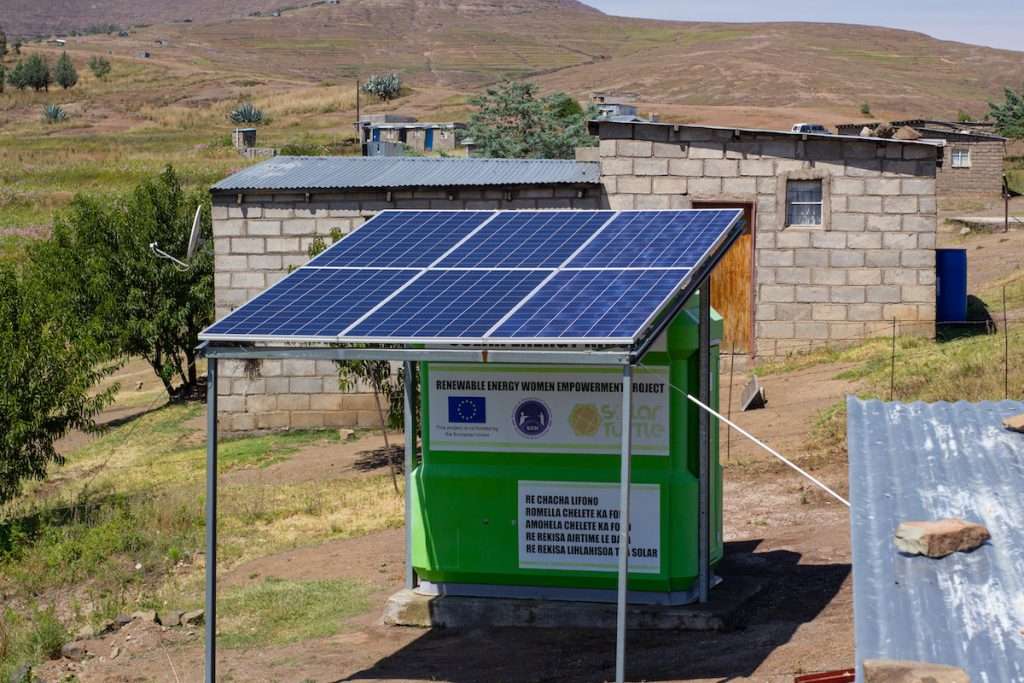
Are there examples of communities where innovative approaches such as mini-grids, solar energy systems, public-private partnerships, or community-driven electrification projects—have successfully increased access to electricity?
Mpotjoane: In areas where mini-grids are operational, communities that would not have access to electricity in the foreseeable future were connected. Out of the 13 mini-grids, 2 are community-based, 11 are privately owned. Currently, there about 4000 off-grid connections achieved as shown.”
What lessons can be drawn from these initiatives?
Mpotjoane: Clear plans define approaches; partnerships mobilise additional funding.”
What role do renewable energy solutions, particularly solar and other off-grid technologies, play in the ministry’s plans to achieve universal electricity access, especially in remote and mountainous areas of Lesotho?
Mpotjoane: They play a very significant role; mini-grids can provide basic electricity services in hard-to-reach areas. Solar home systems can be offered at a much lower cost compared to grid extensions. If renewable energy solutions are fully implemented, we can be able to reach universal access faster.”
What specific targets has the ministry set for increasing electricity access over the next five to ten years, and by when does the government expect to achieve universal access to electricity?
Mpotjoane: When we started the electrification program the target was 15000 connections per annum. The EMP revised the target to 18000 connections per annum. The M300 National Energy Compact recommends about 50000 connections per annum to achieve universal access by 2030.”
Beyond household lighting, how does the ministry measure the impact of electrification on livelihoods, education, healthcare services, employment creation, and local economic development?
Mpotjoane: We conduct post-electrification impact assessments to evaluate the effectiveness of our interventions and generate evidence-based insights. The findings inform the design of future projects, enabling continuous improvement and scalability. These studies also support the integration of emerging innovations, including the promotion of productive uses of energy to maximise socio-economic benefits.”
What opportunities exist for communities, local entrepreneurs, development partners, and the private sector to contribute to accelerating electricity access in areas that remain underserved?
Mpotjoane: Community – promote community-based mini-grids, receive services and opportunities for employment, harness electricity for income-generating activities
Local entrepreneurs – provide service and innovations in mini-grid development, distribution of DREs and clean cooking solutions; they also unlock private financing. Development partners provide technical backstopping, capacity building, and financial support. Private sector provide additional funding, technology, innovation and expertise.”
Looking ahead, what does the ministry consider the most practical and sustainable solution for ensuring that every Mosotho has access to reliable and affordable electricity?
Mpotjoane: The multi-pronged strategy of strategic plans, partnerships and resources within the sector has the potential to intensify service delivery.”

1 Comment