
384 Basotho Health Workers Funded Through Global Fund Face Possible Job Losses
16 July 2026 by Pascalinah Kabi
A total of 384 Basotho health workers employed through the Global Fund grant to the Lesotho government could lose their jobs at the end of the 2026/27 financial year if the government is unable to absorb their salaries into the national health budget. Lesotho’s financial year runs from 1 April to 31 March.
Parliament has urged the government to negotiate with the Global Fund to retain the workers beyond the current grant cycle. Their continued employment will depend on the outcome of those negotiations.
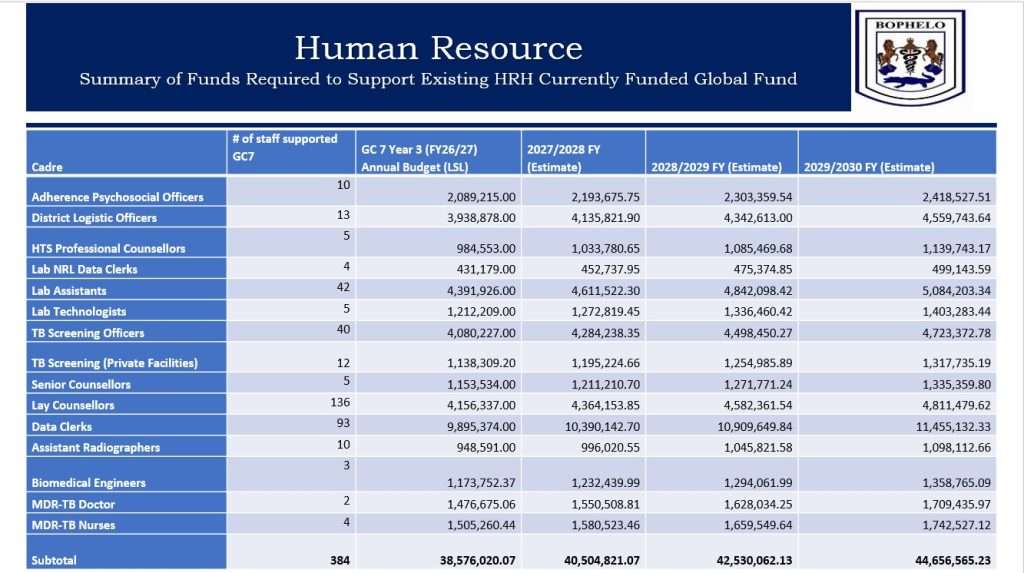
The affected health workers include Adherence Psychological Officers (10), District Logistic Officers (13), HTS Professional Counsellors (5), National Reference Laboratory Data Clerks (4), Laboratory Assistants (42), Laboratory Technologists (5), TB Screening Officers (40), TB Screening Officers at private health facilities (12), Senior Counsellors (5), Lay Counsellors (136), Data Clerks (93), Assistant Radiographers (10), Biomedical Engineers (3), MDR-TB Doctors (2), and MDR-TB Nurses (4).
All 384 health workers are Basotho nationals. During the 2026/27 financial year, which began on 1 April 2026 and ends on 31 March 2027, the Global Fund is expected to spend M38,576,020.07 on the salaries of the 384 health workers under Grant Cycle 7 (GC7).
Nkhala Sefako of the Ministry of Finance and Development Planning said the Global Fund had informed Lesotho that it had been selected to continue receiving funding under GC8.
However, as Lesotho prepares to conclude GC7 and submit its proposal for Grant Cycle 8 (GC8), the Global Fund has reportedly informed the government that it will no longer finance these positions beyond the current financial year. The Fund supports Lesotho’s HIV and tuberculosis programmes.
The possible loss of the 384 jobs emerged during a meeting on 14 July 2026 between the Ministry of Health, the Ministry of Finance and Development Planning, the Global Fund, and Parliament’s Social Cluster Portfolio Committee. The meeting focused on strengthening domestic financing for health.
Speaking before Parliament’s Social Cluster Portfolio Committee, the Ministry of Health’s Acting Director General, Dr Llang Maama, said many of these positions were created as innovative interventions to respond to urgent public health needs.
“Some of these positions funded by donors were created as innovative interventions when there was a dire need for such services. For example, Lesotho has one of the highest tuberculosis burdens in the world, so there was a need to reduce that burden,” Dr Maama said.
She explained that one of the key TB control strategies is active case finding in communities rather than waiting for patients to present at health facilities. As a result, TB screening officers were introduced to implement that policy.
Dr Maama said the country still needs these workers, but added that some of the positions were never intended to be permanent.
“We need them now because we remain one of the highest TB-burdened countries. Once we reach the desired level of disease control, these services can be integrated into the normal health programmes,” she said.
Social Cluster Portfolio Committee Chairperson Mokhothu Makhalanyane questioned why the government had not already created permanent public service positions to absorb the workers.
“You are presenting this list under the 2026/27 financial year, yet we are discussing how government should begin taking over these responsibilities. One available option is to create these positions,” Makhalanyane said.
He also proposed that the Ministry of Health provide subventions to civil society organisations so they could continue employing some of the affected workers if government is unable to absorb them immediately.
“If we delay making decisions, we will create another problem. It took government years to absorb COVID-19 health workers,” Makhalanyane said, adding that recently only about 45 out of more than 200 Covid-19 health workers were finally absorbed into the public service.
Acting Principal Secretary in the Ministry of Health, ‘Matšoanelo Monyobi, said the ministry is already struggling with a significant shortage of health workers.
“Until we secure adequate funding to close that human resource deficit, it will be difficult to determine which of these positions government can absorb. Even now, we have vacant posts awaiting recruitment through the Public Service Commission, including incinerator operators, but recruitment was halted because of funding constraints. We have a serious human resource challenge,” Monyobi said.
Sefako said: “In preparing the GC8 proposal, the Global Fund indicated that all health workers currently supported through the grant should eventually be absorbed by government, whether through integration into the public service or another arrangement.”
She added: “The question is whether government will absorb these positions, and if not, what will happen to these workers. As government and Parliament, what solutions are we putting on the table?”
