

How a Quthing Farming Project Helped Villagers Overcome Drought, Hunger and Unemployment
15 May 2026 by Pascalinah Kabi
A sharp, restless wind swept across Ha Mohlakoana in Quthing district, slicing through the skin of 17 journalists as they stepped out of a 22-seater sprinter.
The biting cold threatened to disrupt their work, but for the villagers gathered there, harsh weather was nothing new. For years, unpredictable weather patterns and water shortages had threatened both their harvests and their survival.
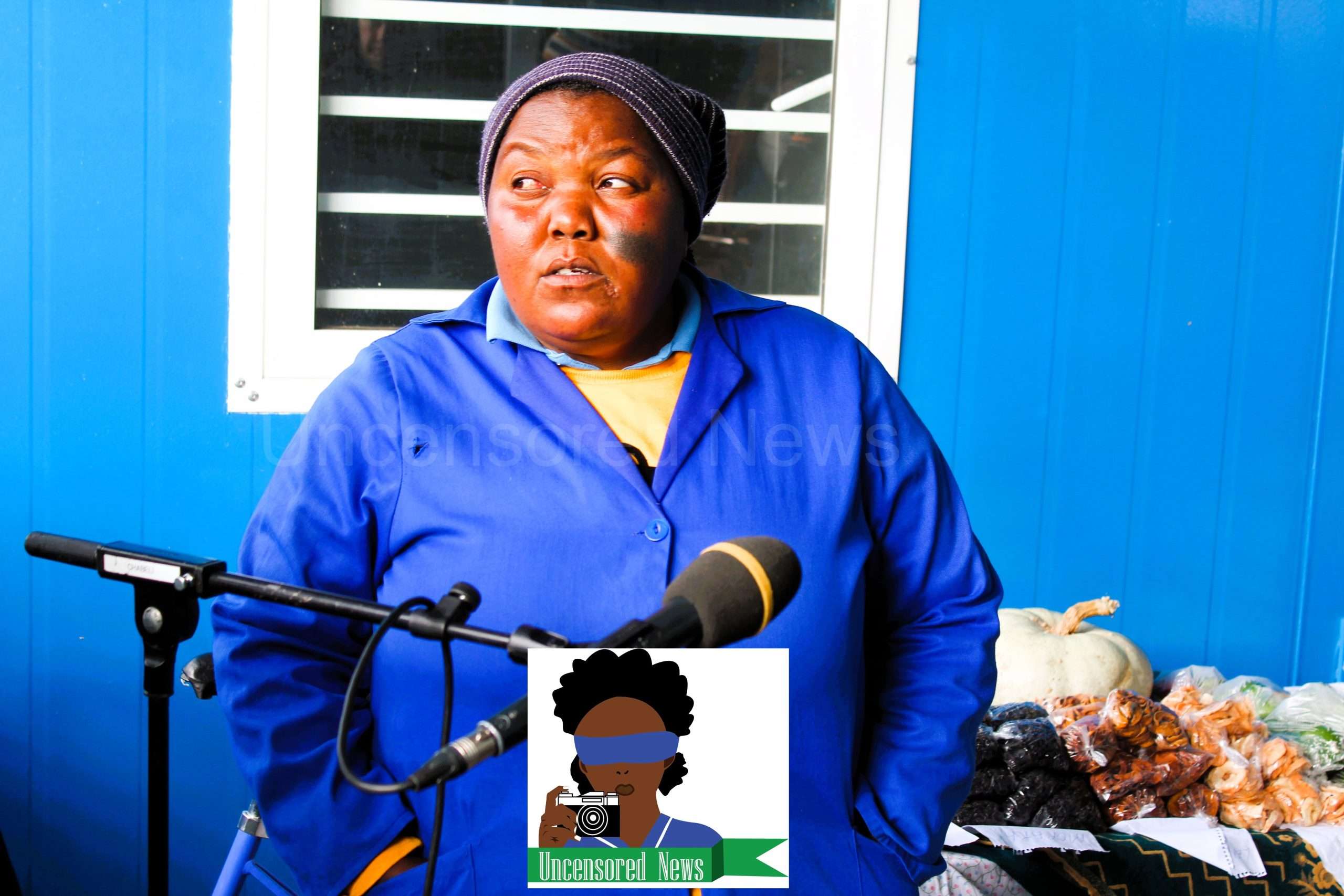
Just after 2 p.m. on 6 May 2026, Lesotho’s Minister of Environment and Forestry, Thabo Mofosi, stood alongside Head of Adaptation Fund, Mikko Ollikainen, listening attentively as 38-year-old ‘Malebohang Moeketse recounted the story of Mohlakoana Garden — a story shaped by hardship, resilience, and climate adaptation.
Moeketse explained that the Mohlakoana Garden project first received support from the World Food Programme between 2017 and 2020. After a year-long pause, the project was revived through the Improving Adaptive Capacity of Vulnerable and Food-Insecure Populations in Lesotho (IACOV) initiative — a climate adaptation programme funded by the Adaptation Fund.
“In 2021, IACOV came and helped us drill for water because water was a serious challenge for us,” Moeketse said. “We produce different types of vegetables and also run a poultry project where we produce eggs.”
Before IACOV intervened, Moeketse said the group struggled to grow tomatoes that met market standards. The project later donated shade nets to the community garden, which has 42 members.
“We now produce tomatoes that meet national and regional market standards,” Moeketse said.
“We sell our vegetables to shops in Mphaki and Mount Moorosi, as well as to people within our community. As for eggs, we sell them to nearby towns, Mount Maluti Hotel, and community members.”
Also watch:
https://web.facebook.com/share/v/1GfoduUJNm/
More funding
According to the Adaptation Fund, Lesotho is experiencing more extreme weather events than in the past. These include long dry spells, repeated droughts, heavy rainfall, floods in some areas, hailstorms, strong winds, and snowfall that comes too early or too late.
The Fund says these weather conditions are expected to become more frequent and severe by 2030, 2050, and 2080. This means the country is likely to face increasingly unpredictable weather, including stronger droughts and heavier rainfall within short periods.
These harsh weather conditions are already affecting farming, which many families rely on for food and income. As crops fail and livestock suffer, many households are facing poverty, hunger, and poor nutrition.
To help communities cope with these challenges, the Adaptation Fund was established under the United Nations climate agreement to finance projects that help countries like Lesotho respond to changing weather conditions.
In Lesotho, the IACOV project — led by the government — supports vulnerable families and communities such as Ha Mohlakoana in Quthing district. The project helps communities improve farming, gain access to water, and protect their food supply and livelihoods from harsh weather conditions.
Speaking to Uncensored News on the sidelines of the Ha Mohlakoana event, Rorisang Kurubally said the IACOV project is implemented by the Ministry of Environment and Forestry together with the Ministry of Agriculture and Food Security, with support from the World Food Programme.
“IACOV Phase I began operating in Lesotho in 2020 to 2025. We got more funding because we have been the best in the countries where the Adaptation Fund is funding. We were approved to go for the second phase of the project. First phase, we got $10 million (M164 million) to implement for four years.
“Adaptation Fund is here to see and to learn from Lesotho, how we succeed at the rate of which we succeeded. They want to come and take the lessons from Lesotho and replicate or introduce them in other countries where they are working,” Kurubally said.
Addressing community members on May 6, 2026, Mikko Ollikainen said the Fund was impressed by the work being done by communities in Lesotho.
“I have come here with my team from Washington to see how the IACOV project is doing in Lesotho, including in your community (Ha Mohlakoana) and in your district (Quthing). We are very impressed with what we see here, so thank you so much for your hard work,” Ollikainen said.
He said the Fund was encouraged to see that the Ha Mohlakoana community had gained new skills through the Mohlakoana Garden project, including poultry farming and vegetable production.
“These products that you have shown us are truly impressive, so we are very pleased to see that.”
Meanwhile, Kurubally said Lesotho has secured an additional US$10 million (M164 million) for the second phase of the IACOV project.
For the next five years, Ollikainen encouraged communities to: “continue participating in the work of the project and to benefit from the support it can provide to your community.”
Direct cash payments
When the World Food Programme first supported the Mohlakoana Garden project, it had just over 100 members drawn from households across the Ha Mohlakoana community.
At the time, members received quarterly payments of M1,200 (about US$73) for their participation in the project. But according to Mohlakoana Garden member Malebohang Moeketse, the payments later became one of the project’s biggest challenges.
“There was a time when the project paused. When the payments stopped, many people abandoned the project and only wanted to return when funding resumed,” Moeketse said.
Moeketse was speaking to 17 journalists hosted by the Ministry of Environment and Forestry during a field visit organised under the Adaptation Fund programme.
Realising that dependence on direct payments was weakening the project, members introduced rules aimed at building commitment and long-term sustainability. One of the rules stated that members who repeatedly missed work would lose their membership and the benefits attached to it, including profit shares equally distributed by the cooperative.
“There were 103 members when we started. We are now a 42-member cooperative legally registered in Lesotho,” Moeketse said. “The project helped us become commercial farmers. When we first started, we knew nothing about commercial farming.”
The shift from subsistence farming to commercial agriculture is increasingly seen as one way to improve food security and household incomes in Lesotho.
A 2024 study published by Taylor & Francis found that Lesotho faces a “triple burden of malnutrition,” including stunting, micronutrient deficiencies, and overweight among both children and adults.
According to the study’s authors — Nthabeleng Nkoko, Natasha Cronje, and Willem Jan Swanepoel — agriculture in Lesotho has changed significantly over the past decade, with increased support from government and development partners to help farmers move from subsistence farming to commercial production.
The authors noted that commercial farming can help create jobs, reduce poverty, and improve resilience to climate shocks.
One participant quoted in the study said commercial farming households often earn more income because they are better able to cope with changing weather conditions than subsistence farmers. The additional income, the study noted, contributes positively to household food and nutrition security.
Moeketse shared similar sentiments, saying the project had changed the lives of many women in the community.
“As women, we did not have many skills before. We would wake up in the morning and spend the day doing nothing. But now, many women have shade nets at their homes, allowing them to continue farming even when it is not their turn to work at the project site,” Moeketse said.
“We are now able to sell our produce both as individuals and as a cooperative.”
Undervalued products

On May 6, 2026, the Mohlakoana Garden cooperative displayed a variety of products for community members and visitors to buy. The products included canned peaches, dried fruits, fresh vegetables, eggs, and clothing worn by women from the Ha Mohlakoana community.
While the display reflected the community’s growing efforts to add value to its produce, one detail stood out. The women had recycled used bottles or jars to package their canned peaches, with some lids still carrying labels and branding from large international companies.
The packaging drew criticism from Lesotho’s Minister of Environment and Forestry, Thabo Mofosi, who said local farmers needed support to properly brand and package their products.
“What disappoints me is that our people have made a serious effort to commercialise their produce, but branding remains a major challenge. It is unacceptable that we still see mayonnaise branding on their products,” Mofosi said.
He said packaging plays an important role in attracting customers and increasing the market value of locally produced goods. According to Mofosi, proper branding would help farmers compete in larger markets, including franchise and retail stores that stock international products.
“It should clearly show that this is a product from Lesotho, and we should be proud of it,” he said.
Mofosi urged government programmes such as the Smallholder Agriculture Development Project II (SADP II) to work closely with the ministries responsible for agriculture and environment to help local farmers develop better branding and packaging solutions.
“We must start small, even with simple packaging solutions right here where we are, to add value to these farmers’ products,” he said.
While the Mohlakoana Garden still lacks professional branding for its products, the cooperative has built a strong culture of financial transparency and accountability.
“We have three separate accounts — one for vegetables, another for eggs, and one for fruits,” Moeketse said. “We sit down together and review the performance of each account openly. If one account is not doing well, we do not share its profits immediately. We allow the business time to recover.”
According to Moeketse, the poultry project has become the cooperative’s strongest source of income.
“The egg business is the most successful because demand is very high. Sometimes we are unable to meet all our customers’ needs,” she said.
Profits are shared equally among members, with each person expected to spend one day per week working at the garden. Members also contribute a monthly subscription fee of M20, which adds to the cooperative’s savings and profits.
Moeketse said transparency in handling finances has helped the project survive, even during periods when donor funding was unavailable.
“We managed to keep the project running even when there were no funders because there is transparency around our finances. Every member has access to the financial records,” she said.
