
A Herder’s Cracked Plate
1 June 2026 by Pascalinah Kabi
An old enamel plate, cracked, chipped and warped out of shape by years of use, sits alone among five modern glass plates on a dining table.
The warped out plate is not reserved for a family member. It belongs to *Thabiso, the family’s herder.
Outside, near the kraal, Thabiso waits patiently for what will be his second and final meal of the day. Employed to look after the family’s cattle, sheep, goats and horses, he is expected to protect their wealth through scorching summers, freezing winters and dangerous storms. Yet, when it is time to eat, he is often reminded of where he stands in the household hierarchy.
“When you arrive at that house, there is a plate on the table that resembles a plate used to feed a dog. It is the plate a herder feeds from,” says Inspector Pokane Mochochoko, describing the discrimination many herders endure daily.
Inspector Mochochoko commands the Matela Police Station, located about 50 kilometres from Maseru, Lesotho’s capital city.
“The food served to a herder is different from the food reserved for your children. The plate used to serve him is one you would never use to serve your own children,” he explains.
Rangelands and pastoralists
According to Lesotho’s 2014 National Range Resources Management Policy, the country covers approximately 30,055 square kilometres, or three million hectares. About 60 percent of this land consists of rangelands.
“Rangelands play a pivotal role for Lesotho. The pride and wealth of Basotho are rooted and reflected in the rearing and ownership of livestock, which depends entirely on rangelands,” the policy states.
The document warns that these rangelands are under severe stress and experiencing rapid declines in productivity. Fertile soils derived from mineral-rich basalt rock, which have historically supported valuable grass species such as themeda triandra liremo, are increasingly degraded.
The policy further attributes the degradation of natural grazing lands partly to changing land-use patterns, including the breakdown of traditional seasonal grazing systems caused by rising stock theft.
Recognising the importance of these ecosystems, the United Nations designated 2026 as the International Year of Rangelands and Pastoralists. The initiative highlights the critical role rangelands and livestock-dependent communities play in sustaining food systems, biodiversity, livelihoods and the environment.
Rangelands are vast areas of natural grasslands, shrubs and open landscapes where livestock such as cattle, sheep and goats graze. In Lesotho, mountain grazing areas and village pastures form part of these rangelands.
Pastoralists are people whose livelihoods depend primarily on raising livestock.
Throughout the year, the UN observance focuses on different themes. The theme for May 2026 was “Biodiversity and Ecosystem Services of Rangelands,” highlighting how healthy ecosystems provide essential benefits such as clean water, fertile soil, fresh air and grazing resources.

On 20 May 2026, Lesotho marked the occasion at Metolong in Maseru, where herders were recognised as key stakeholders in the protection and restoration of rangelands.
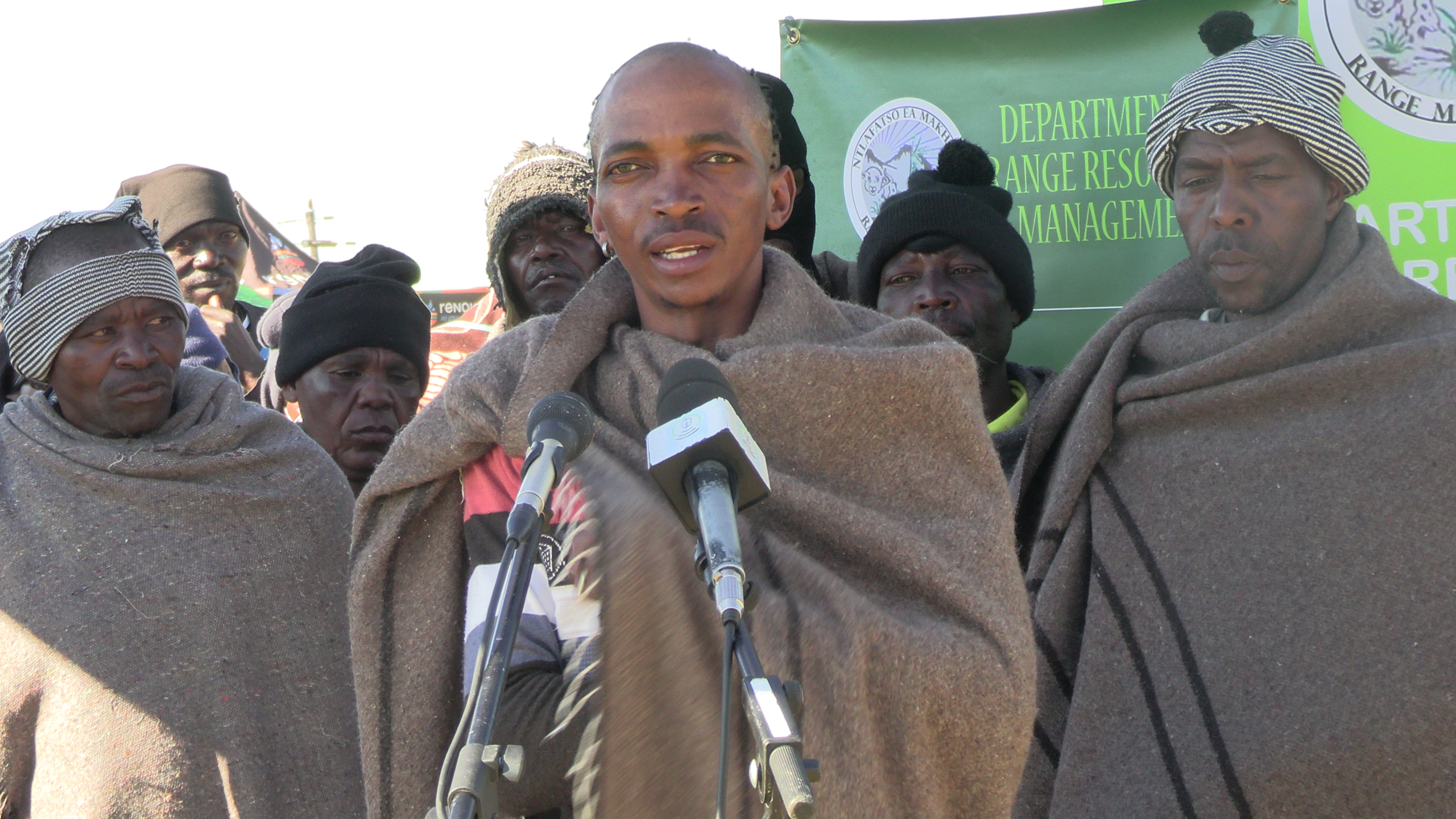
Yet even as herders were being celebrated for their contribution to environmental conservation — with farmers and stakeholders dressed in grey blankets and gumboots, attire popularly associated with herders — Inspector Mochochoko used the platform to highlight what he described as a troubling contradiction.
According to him, herders remain among the most undervalued and mistreated workers in the livestock sector.
“A herder protects your livestock armed with nothing more than a fighting stick. He looks after your animals and helps them multiply, yet at the end of the day, some employers breach the agreements they made with him,” he said.
Inspector Mochochoko said his office frequently receives reports of livestock owners who deliberately create conflicts with herders as payment time approaches.
“I have a serious challenge of reports that employers intentionally cause disputes so they can dismiss herders before payment is due, allowing them to leave without receiving what they have worked for,” he says.
In many cases, herders work for an entire year without receiving wages. Instead, they are compensated at the end of their contract with livestock, often a cow or other animals agreed upon at the start of employment.
Inspector Mochochoko questions what happens when a herder who has endured months of harsh weather, loneliness and difficult working conditions is dismissed without receiving the promised compensation.
“When a worker who has suffered through the cold leaves without pay, what do you think his heart is telling him to do?” he asks.
He urges livestock owners to treat herders fairly, arguing that respecting workers’ rights is also an effective strategy for preventing stock theft.
“Farmers must carefully reflect on this issue because treating herders well is one way of preventing stock theft,” he says.
For many herders, the cracked plate waiting on the table is more than a feeding dish. It is a symbol of exclusion and neglect.
Nathanael Chele Lempe, a member of the Monna-ka-Khomo Herders Grazing Association and a resident of Ha Seeiso in Metolong, spoke at the May 20, 2026 event.
“I am a herder, my elders,” Lempe told the gathering.
“All the challenges a herder faces, I have experienced. As speakers come to the podium, they give me hope that one day we will receive the help we need.”
On 30 May 2026, Uncensored News published Inspector Mochochoko’s video on its Facebook page.
Also watch: https://web.facebook.com/reel/990649623711879/?s=fb_shorts_profile&stack_idx=0
One commenter, Atang Muso, wrote: “Gentleman, you have just opened an old wound when I think of the life I once lived at Koro-Koro. The pain of herding someone’s livestock. The hardships are beyond measure.”
Another follower, Matlhonolofatso Khafo, said: “The police officer is telling the truth. Rich people are selfish. It is okay that you are telling them that we steal their livestock because they don’t pay us. I still have evidence of when I was not paid in 2018. Please help me.”
“Gentleman, I was not paid for three years, from 2015 to 2017. No pay,” wrote Tbo Mqb Ks.
Minister’s take
Minister of Environment and Forestry Thabo Mofosi has pleaded with farmers to take care of herders’ wellbeing, arguing that mistreatment of herders can fuel resentment and undermine livestock management.
He also proposed replacing the term balisana (herders) with a more dignified title as part of broader efforts to improve their treatment.
“I am not wearing a grey blanket just for show. Taking care of herders is at the heart of protecting rangelands and advancing the economic emancipation of farming families.
“Fellow herders, we are here. The Right Honourable Prime Minister said he wants you to experience the quality of life available in the lowlands while you are working in the highlands. We need to start by ensuring that herders living at cattle posts are not exposed to danger. That is our starting point,” Mofosi said.
He said it is unacceptable that herders continue to die in the highlands after becoming trapped in heavy snow. Stakeholders, he argued, must ensure that herders have access to mobile phones so they can communicate easily and receive weather updates.
Without herders, the protection of rangelands would be almost impossible, Mofosi said, acknowledging the work that herders and grazing associations have already undertaken, often on a voluntary basis.
New hope
At Metolong, long before population growth and weakening controls over rangelands, Khalong la Motheba was renowned for its rich grazing resources and its role in protecting Lesotho’s fragile topsoil.
Over time, however, environmental degradation transformed the area into a source of concern for farmers, herders, village authorities and officials from the Ministry of Environment and Forestry.
One of the initiatives established to rehabilitate the area was the Tloboneng Khalong la Motheba Grazing Association, whose name loosely translates to “Come and See at Motheba’s Opening.”
During the May 2026 commemoration in Metolong, both the Tloboneng Khalong la Motheba Herders Grazing Association and the Monna-ka-Khomo Herders Association were officially presented with their constitutions — critical governance documents that will help them manage their affairs and access funding from institutions that support environmental conservation.
Speaking on behalf of the Tloboneng Khalong la Motheba Herders Grazing Association, Sethuoa Rapulane explained how rehabilitation efforts have helped restore the area.
“The area has improved, although it was better in the past. As it deteriorated, shrubs began to dominate. There was more shrub than grass and everything valuable disappeared. But since officials came and helped us rehabilitate the area, everything is returning, including medicinal plants that benefit our communities,” Rapulane said.
He said members were proud of the progress achieved so far.
“We are happy. Ladies and gentlemen, we are looking for your support to protect our rangelands because they are a source of income for the men and women of this village,” he said.
Rapulane noted that livestock, particularly in the lowlands, remain a vital source of income for many households. He called on herders to respect the Khalong la Motheba grazing area because it forms the foundation of their livelihoods.
As cracked plates remain a symbol of the poor treatment many herders endure, Inspector Mochochoko urged farmers to reconsider how they view men who look after their livestock.
Some of those herders, he said, are handsome enough to become their employers’ sons-in-law, given that farmers also have beautiful daughters.
“If you treat a herder well, he will take good care of your livestock, helping your herd multiply for the economic benefit of your family. Let us go back to our homes and start respecting herders,” Inspector Mochochoko said.
